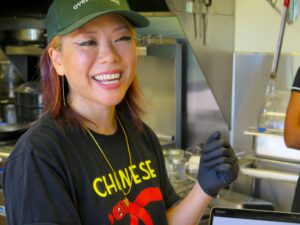
 “These are stories that confirm humans are good people,” says Feng-Feng Yeh of Chinese Chorizo Project—and, at this point in human history, who isn’t seeking confirmation of goodness?
A group of us are squeezed inside a tiny cooking demo kitchen not far from the Chinese Garden at Tucson’s Mission Garden. Located at the base of Tucson’s signature “A” Mountain (aka Sentinel Peak), the four-acre garden is an immersive outdoor museum that blooms on the site of the original Native American village of S-cuk Shon (pronounced “Chuk-shon”).
Outside, the sun is shining with triple-digit intensity while scores of volunteers harvest and weed and prune heritage crops and heirloom trees. Already we’ve nibbled on Seville oranges, loquats, quince, fava beans, peas, and several edible plants—and now Yeh is preparing her signature Chinese chorizo wrapped in collard green sourced from the garden.
In 2015, Tucson was designated as the first UNESCO Creative City of Gastronomy in the United States. For 4,000 years, the fertile floodplain along the Santa Cruz River has been cultivated by the Indigenous, Mexican, European, Chinese, and African communities, all of whom have left their mark upon the cuisine of Tucson. In short, what you eat in Tucson is the result of millennia of gastronomic heritage. While Chinese chorizo might sound like a slip of the tongue, this Spanish-style sausage made with Chinese spices is a culinary legacy of Tucson’s Chinese groceries and a symbol of cultural resilience.
Throughout the 19th and 20th centuries, nearly 600 Chinese grocers served Tucson’s burgeoning population, providing credit and community for Mexican residents and their neighborhood restaurateurs. In the face of racist legislation such as the 1882 Chinese Exclusion Act, Chinese chorizo fostered a symbiotic solidarity amongst Tucson’s various ethnic populations. According to local folklore, Mexican restaurateurs would take down a patron’s order and then slip out the back door to the Chinese grocer where they would buy on credit so they could prepare the restaurant food. As Yeh attests, “My family is alive because of these groceries.”
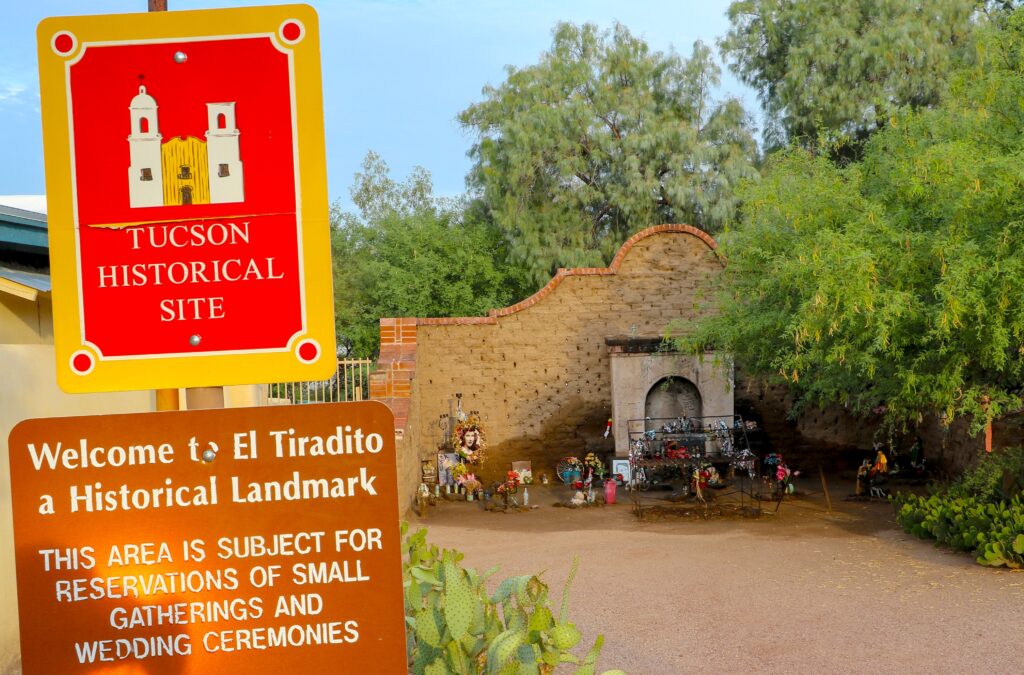
El Tiradito (photo courtesy of Visit Tucson)
Tucson is located about 60 miles from the Mexican border and the state of Sonora, so it’s not surprising that the city proudly bears the title of America’s Best Mexican Food. After all, this is the town that made the Sonoran Dog the winner of a James Beard Award. Tucson’s signature street food is a griddle-crisp hot dog wrapped in bacon and slathered with pinto beans, chopped tomato and onion, mayonnaise, mustard, and salsa.
Fresh seafood from the Sea of Cortez enables Tucson chefs to prepare bold ceviches, aguachiles, and mariscos. At Tito + Pep, the mesquite-flamed food is overseen by the James Beard semi-finalist, Chef John Martinez. If you feel inclined to add some mesquite-grilled shrimp to your vegan posole, you can wash it all down with a mezcal cocktail named for the Chiricahua hoodoos.
In Barrio Hollywood, patrons line up outside Barista del Barrio for the mouth-watering breakfast burritos that started from a small coffee cart run by a single mother supporting two children. As we eat our way through Tucson’s neighborhoods, it’s clear that Mexican culinary influence is woven into nearly every aspect of food in Tucson; it’s the foundation from which every kitchen rises.
The story of Tucson is one of collective power and community spirit. Due to its close proximity to the Mexican border, Tucson has been on the front line of the immigrant experience in the United States. As we wander into Barrio Viejo, one of Tucson’s most historic neighborhoods notable for its collection of Sonoran row houses, our guide Mauro reminisces about his extended family and the multicultural bonds that existed within the blue-collar community throughout the 20th century.
Once home to numerous Chinese grocers, Barrio Viejo has undergone a 21st-century renaissance with the opening of numerous bars and restaurants and the upcoming redevelopment of the beloved Teatro Carmen. Diane Keaton kept a home in Barrio Viejo and it’s easy to see why she succumbed to the neighborhood’s low-key charms and historic character.
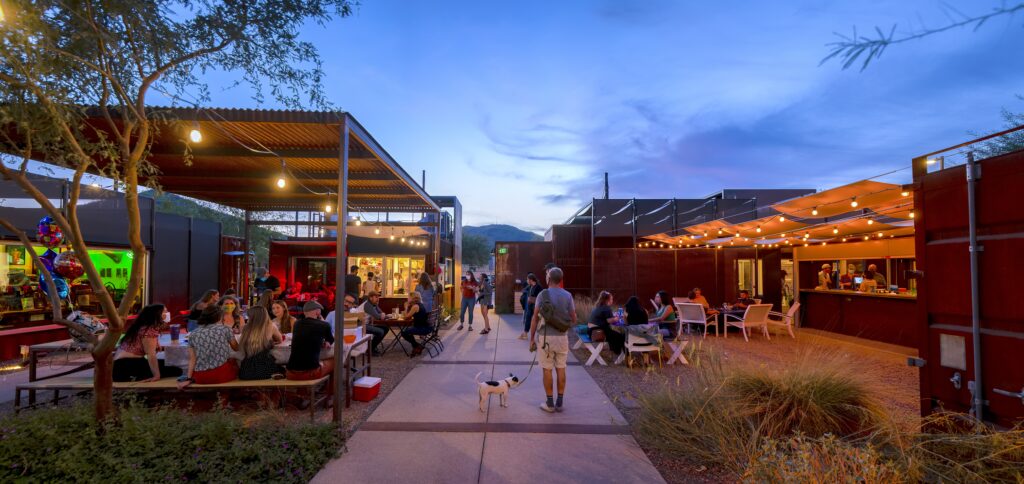
Mercado San Agustin Annex (photo courtesy of Ulises Escobar & Visit Tucson)
Similarly, the neighborhood known as Menlo Park is home to Mercado San Agustin, Tucson’s first public market, and the Annex, an open-air plaza of 15 local businesses housed inside retrofitted shipping containers complete with A/C. According to Tony Ray Baker (aka The Gay Realtor), the Mercado District is in the process of becoming a quasi gayborhood, due to its centralized location and design-savvy homes interspersed with clever shops. In other words, every bougie gay’s dreamhood. As Baker states with enthusiasm, “I’ve been in Tucson my entire life, and never have I been uncomfortable as a gay person in Tucson.”
Indigenous people have lived in what is now known as Arizona for thousands of years, and many of these people have celebrated human sexuality and gender variance. It was the Tohono O’odham who used the term “wi:k’ovat” for males who acted, dressed, and behaved as female. This history of inclusion and acceptance has filtered down through the centuries, and in 1977, Tucson became one of the first municipalities in the States to pass anti-discrimination ordinances to protect sexual minorities. Tucson’s first queer bar opened in 1970 and when Tucson Pride was founded in 1977, it was the first Pride in the state of Arizona.
At Galeria Mitoteria in South Tucson, co-owners Mel Dominguez and Melissa Brown-Dominguez have created a Latinx/queer-owned gallery and community space that offers a safe place for queer and Latin artists to cultivate their creativity and celebrate their culture. After more than seven years in South Tucson, the two Mels have become youth mentors and an integral part of the evolving neighborhood. Similarly in Barrio Hollywood, Yōlia Botánica is a Mexican apothecary owned and operated by Lupita Tineo who was born in Sonora, Mexico. As a queer undocumented American for nearly 17 years, Lupita achieved legal status in 2019, whereupon she opened her botanica to assist others in the practice of ancestral spiritual healing traditions.
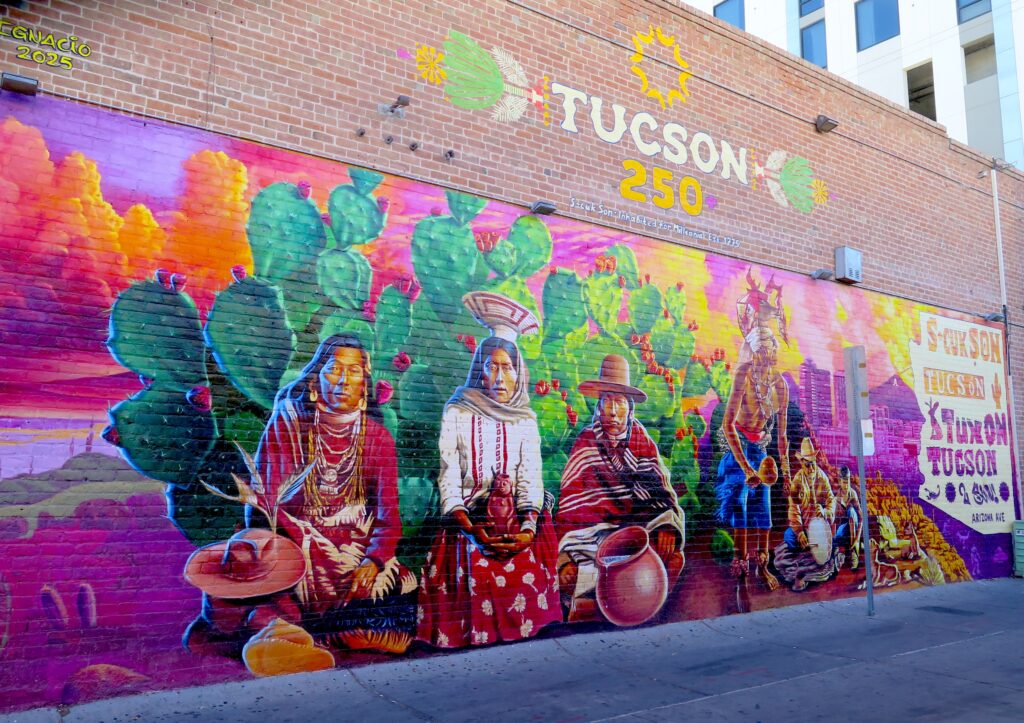
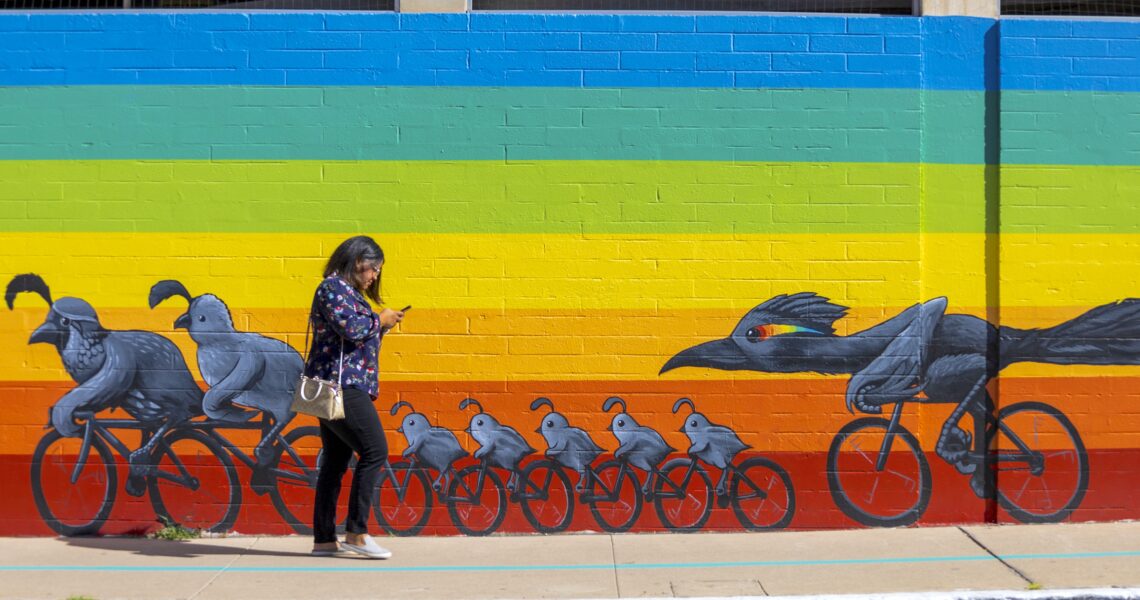
Sesquicentennial mural in downtown Tucson (photo courtesy of MRNY)
Tucson’s tourism slogan is “Don’t Fit Right In”—because in Tucson, residents invite you to stand out and stand up for who you are. Tucsonans respect difference and expect it. In Tucson, it’s what’s original that matters. Instead of a reception desk to welcome us into our hotel, there’s a unicorn zebra—because in Tucson, you showcase your horn and wear your stripes with pride. As one local purveyor puts it, Tucson is The Underestimated City—and there’s no greater motivation for punching above your grade.
Misfits and dreamers have been hugely influential throughout Tucson’s history, and as we tour through town on a Tucson Trolley Tour, we hear folklore about unsolved murders, eccentric philanthropists, stolen art, and Wyatt Earp. Back at the Hotel Congress which dates from 1919, we head into the Cup Café where the menu features John Dillinger on its cover. Dillinger and his gang were guests at the hotel when a fire broke out and caused their capture due to a suitcase stuffed with stolen cash.
The University of Arizona was established in Tucson in 1885, partially as a consolation prize for losing the capital to Phoenix, but Tucson has had the last laugh as the university has become the center of Optics Valley (or Silicon Desert), notable for its optics technology and telescope research and the next generation of monolithic honeycomb mirrors.
Equally groundbreaking for the university was the founding of the Center of Creative Photography (CCP) in 1975 by photographer Ansel Adams. Currently, the CCP holds more than eight million objects, including 270 archival collections from photographers such as Adams, Edward Weston, and Garry Winogrand.
Notable for its spectacular sunsets and breathtaking landscapes, Tucson provides daily inspiration to its many artists, many of whom are featured at the Tucson Museum of Art. The museum’s permanent collection includes the works of Indigenous, Latin American, and Asian artists, as well as art of the American West.
On another triple-digit afternoon, we wander the museum’s grounds which encompass a block of historic buildings from Tucson’s past. As we enter La Casa Cordova, an adobe home from the 1840s, we’re greeted by an immersive installation of a typical Tucson Chinese grocery store.
Created by Feng-Feng Yeh and the Chinese Chorizo Project, Vivamos Siempre Como Hermanos is an homage to the many Chinese grocers and small businesses that contributed to the multicultural story of Tucson. As Yeh states with pride, “In Tucson, there’s a lot of trust, and a willingness to collaborate. There’s a lot of thoughtfulness here in Tucson.”
The installation’s title Vivamos siempre como hermanos translates to “Let us always live as brothers”—and in Tucson, that utopian dream might be close to reality.
Last modified: August 16, 2026